

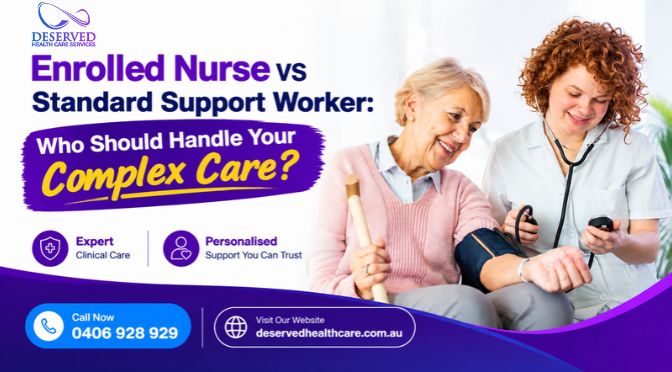
When your health needs become more complex, choosing the right support isn’t just about convenience; it’s about safety, clinical responsibility, and getting the right person for the job.
For NDIS participants, understanding when you need an enrolled nurse rather than a standard support worker can prevent avoidable risks while ensuring your care remains person-centred.
The Key Difference: Clinical Care vs Daily Support
A support worker can assist with everyday activities and disability-related support, while an enrolled nurse is a qualified healthcare professional who works within their scope of practice and under appropriate supervision.
If you’re arranging disability care services in Melbourne, the right choice depends on what your care actually involves.
A support worker may assist with:
- Personal care and grooming
- Meal preparation
- Mobility and transfers
- Community access
- Household tasks
- Routine daily living support
- Following established care instructions
An enrolled nurse may be appropriate for:
- Medication-related clinical tasks
- Wound and skin care
- Continence-related clinical needs
- Catheter care
- Health monitoring
- Complex care routines
- Other nursing interventions requiring clinical judgement
The important point? Not every health-related task should automatically be delegated to a support worker.
When Does Community Nursing Become Necessary?
Imagine you require regular wound management, have a complex medication routine, or need clinical monitoring that changes according to your health status.
That’s where community nursing in Melbourne can provide a more clinically appropriate level of support.
An enrolled nurse can assess the task, work within their professional scope, follow relevant clinical directions, and escalate concerns when something doesn’t look right.
This can be particularly important when your care involves:
- Changing health conditions
- Complex medication requirements
- Post-hospital care
- Chronic health needs
- Clinical observations
- Wound management
- Continence or catheter-related care
What If You Need Both?
You don’t necessarily have to choose one or the other.
For many participants, the most practical approach is coordinated nursing and disability support, where each professional handles responsibilities suited to their role.
For example:
- Nurse: Completes clinical wound care and monitors changes.
- Support worker: Assists with personal care and daily routines.
- Participant: Remains involved in decisions about their care.
- Care team: Communicates concerns and follows the appropriate care plan.
This approach can make disability care services in Melbourne feel less fragmented while helping you receive the right support at the right time.
Don’t Risk Using the Wrong Level of Support
One of the biggest mistakes is assuming that a support worker can perform a clinical task simply because they have done something similar before.
The safer approach is to consider:
- Is the task clinical?
- Does it require nursing knowledge or judgement?
- Is there a documented care plan?
- Does the worker have the appropriate training and authorisation?
- What happens if your condition changes?
When there’s uncertainty, professional assessment and appropriate clinical oversight matter.
Get Community Nursing That Fits Your Needs
Your care shouldn’t be built around a generic checklist. Whether you need nursing interventions, daily living assistance, or coordinated support, the goal should be safe care that respects your preferences and supports your independence.
Deserved Health Care Services can help you understand the appropriate level of support for your circumstances and connect your care needs with suitable services.
If you’re looking for community nursing in Melbourne or personalised disability support, take the next step towards safer, more confident care. Talk to our team today and discuss what your care actually requires.
Frequently Asked Questions
Can a support worker recognise when a health task needs escalation?
Yes. A trained support worker can observe changes, follow established instructions and escalate concerns to the appropriate health professional, but they should not independently undertake tasks outside their role or competence.
Can an enrolled nurse support someone who needs assistance across multiple areas of daily life?
Yes. An enrolled nurse can contribute to coordinated care where clinical needs sit alongside everyday disability support. Quality disability care services in Melbourne should ensure each responsibility is handled by someone appropriately qualified.
Does needing medication support automatically mean I need an enrolled nurse?
Not necessarily. The type of medication assistance, the complexity involved, the participant’s circumstances and applicable requirements all need to be considered before deciding who should provide the support.
What happens when a participant’s routine care suddenly becomes more clinically complex?
The care arrangement may need to be reviewed rather than simply continuing with the same support model. Access to community nursing in Melbourne can provide appropriate clinical input when a participant’s health needs require nursing expertise.
Can one care team include both nurses and support workers?
Absolutely. Combining professionals can create a more practical care model, with nurses handling appropriate clinical responsibilities while support workers assist with daily routines and community participation.
Who should review a support arrangement after a hospital discharge?
A qualified health professional should help determine whether the participant’s post-discharge needs have changed. Depending on those needs, disability care services in Melbourne may be coordinated with nursing support to create a safer transition home.
Is a support worker suitable for someone whose condition changes frequently?
It depends on the nature of those changes and the tasks involved. Where changing symptoms require clinical assessment, nursing involvement may be more appropriate than relying solely on routine disability support.
Can nursing support be incorporated without taking away a participant’s independence?
Yes. Good care should complement independence rather than replace it. The aim is to provide clinical assistance where necessary while supporting the participant to remain involved in everyday decisions and routines.

